(↓EN)L-AIR ARTIST IN RESIDENCE & SUPPORT PROGRAM
2026 Season 3|招聘アーティスト紹介
第9期・16人目となる 2026年 Season 4 に招聘されるアーティスト
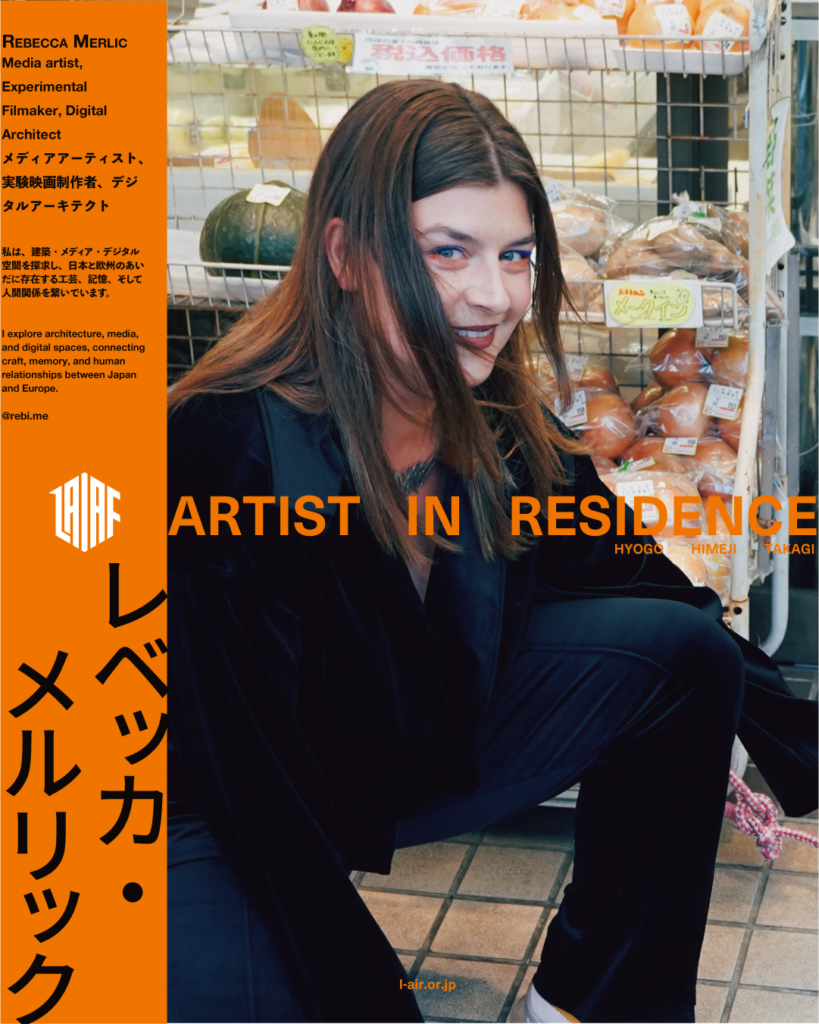
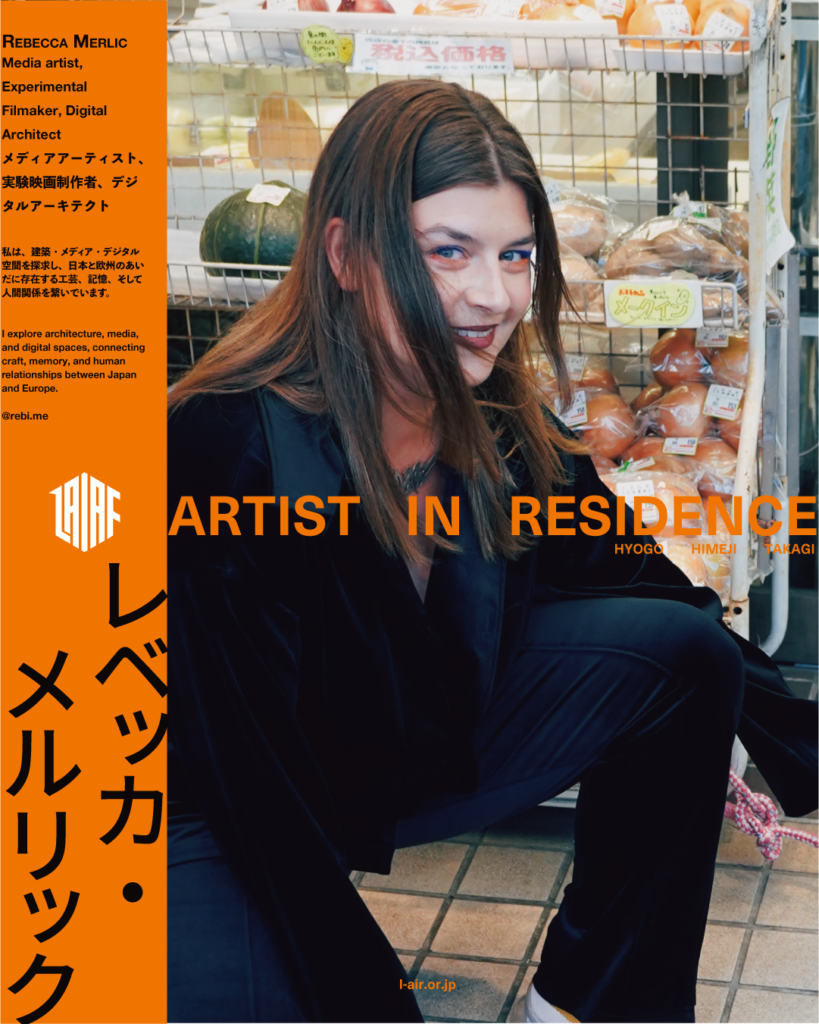
レベッカ・メルリック (Miron Rabetskii) さん
をご紹介します。
アーティストは2026年10月上旬から12月の約3か月間、兵庫県姫路市にある、タンナーが集まる工場地帯・高木に滞在し、作品制作を行います。
L-AIRは、日本有数の皮革産地・兵庫県姫路市「高木」を拠点とする、皮革(Leather)に特化したアーティスト・イン・レジデンス(Artist in Residence)です。国内外のアーティストと地域産業をつなぎ、未だ見ぬ新たな表現の創造と地域の活性化を目指しています。
アーティストがこれまで追求してきた芸術表現と、姫路が誇る皮革産業との融合に挑み、これまでにない新たな表現の創出を目指します。
既存の枠を越えた試みと探求が、ここから始まります。
ぜひ、その過程と成果にご注目ください。
■招聘アーティスト
レベッカ・メルリック (Miron Rabetskii)
2026年 10月上旬 ~ 12月20日(日)
Instagram → https://www.instagram.com/rebi.me
ドイツのヴァラジュディン(クロアチア)生まれ、ウィーン在住
メディアアーティスト、実験映画制作者、デジタルアーキテクト
■略歴
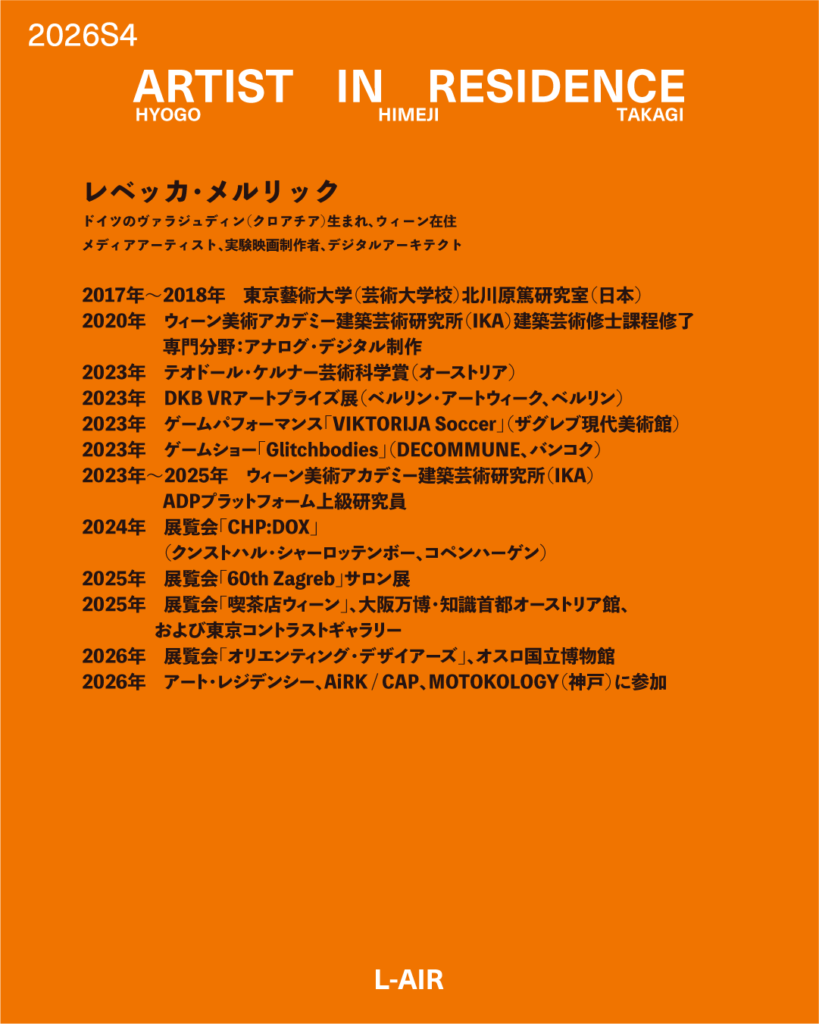
2017年~2018年 東京藝術大学(芸術大学校)北川原篤研究室(日本)
2020年 ウィーン美術アカデミー建築芸術研究所(IKA)建築芸術修士課程修了
専門分野:アナログ・デジタル制作
2023年 テオドール・ケルナー芸術科学賞(オーストリア)
2023年 DKB VRアートプライズ展(ベルリン・アートウィーク、ベルリン)
2023年 ゲームパフォーマンス「VIKTORIJA Soccer」(ザグレブ現代美術館)
2023年 ゲームショー「Glitchbodies」(DECOMMUNE、バンコク)
2023年~2025年 ウィーン美術アカデミー建築芸術研究所(IKA)ADPプラットフォーム上級研究員
2024年 展覧会「CHP:DOX」(クンストハル・シャーロッテンボー、コペンハーゲン)
2025年 展覧会「60th Zagreb」サロン展
2025年 展覧会「喫茶店ウィーン」、大阪万博・知識首都オーストリア館、および東京コントラストギャラリー
2026年 展覧会「オリエンティング・デザイアーズ」、オスロ国立博物館
2026年 アート・レジデンシー、AiRK / CAP、MOTOKOLOGY(神戸)に参加
■ステートメント
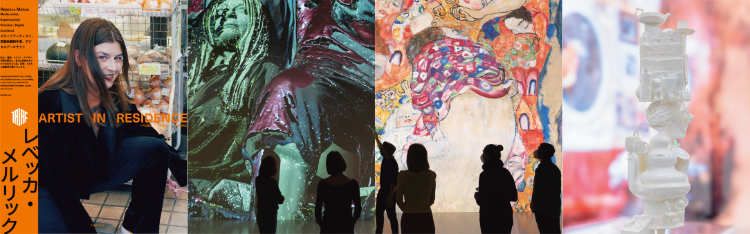
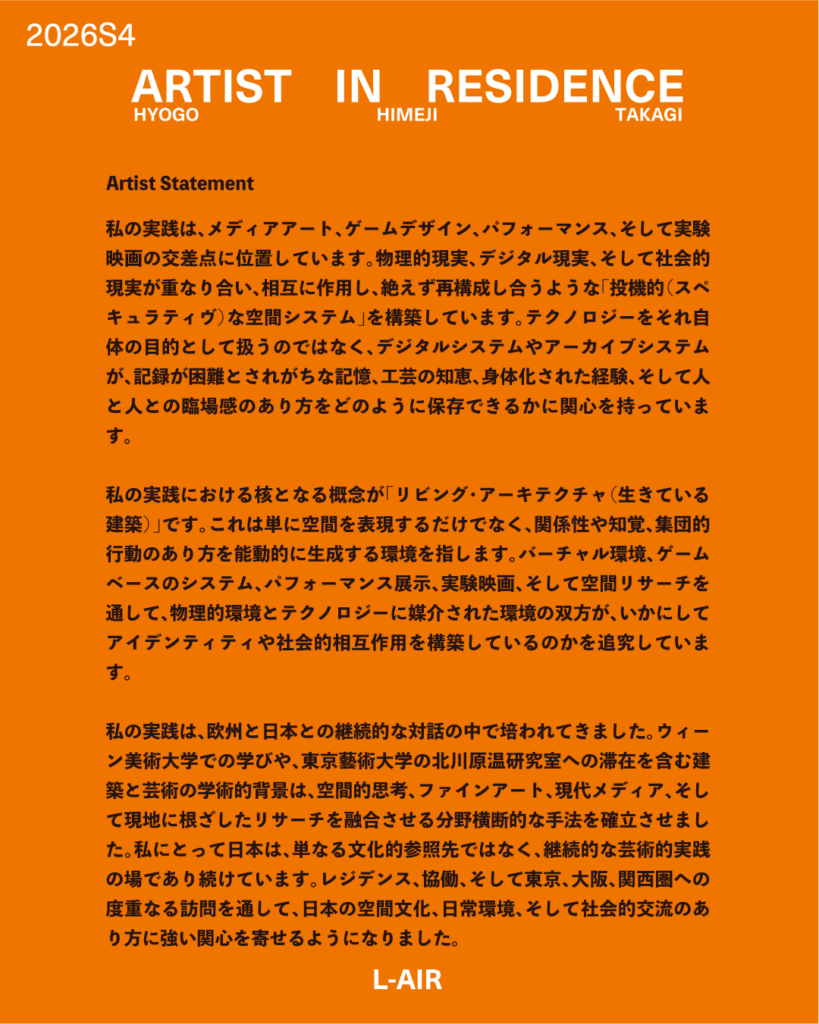
私の実践(アクティビティ)は、メディアアート、ゲームデザイン、パフォーマンス、そして実験映画の交差点に位置しています。物理的現実、デジタル現実、そして社会的現実が重なり合い、相互に作用し、絶えず再構成し合うような「投機的(スペキュラティヴ)な空間システム」を構築しています。テクノロジーをそれ自体の目的として扱うのではなく、デジタルシステムやアーカイブシステムが、記録が困難とされがちな記憶、工芸の知恵、身体化された経験、そして人と人との臨場感(プレゼンス)のあり方をどのように保存できるかに関心を持っています。
私の実践における核となる概念が「リビング・アーキテクチャ(生きている建築)」です。これは単に空間を表現するだけでなく、関係性や知覚、集団的行動のあり方を能動的に生成する環境を指します。バーチャル環境、ゲームベースのシステム、パフォーマンス展示、実験映画、そして空間リサーチを通して、物理的環境とテクノロジーに媒介された環境の双方が、いかにしてアイデンティティや社会的相互作用を構築しているのかを追究しています。
私の実践は、欧州と日本との継続的な対話の中で培われてきました。ウィーン美術大学での学びや、東京藝術大学(藝大)の北川原温研究室への滞在を含む建築と芸術の学術的背景は、空間的思考、ファインアート、現代メディア、そして現地に根ざしたリサーチ(situated research)を融合させる分野横断的な手法を確立させました。私にとって日本は、単なる文化的参照先ではなく、継続的な芸術的実践の場であり続けています。レジデンス、協働、そして東京、大阪、関西圏への度重なる訪問を通して、日本の空間文化、日常環境、そして社会的交流のあり方に強い関心を寄せるようになりました。
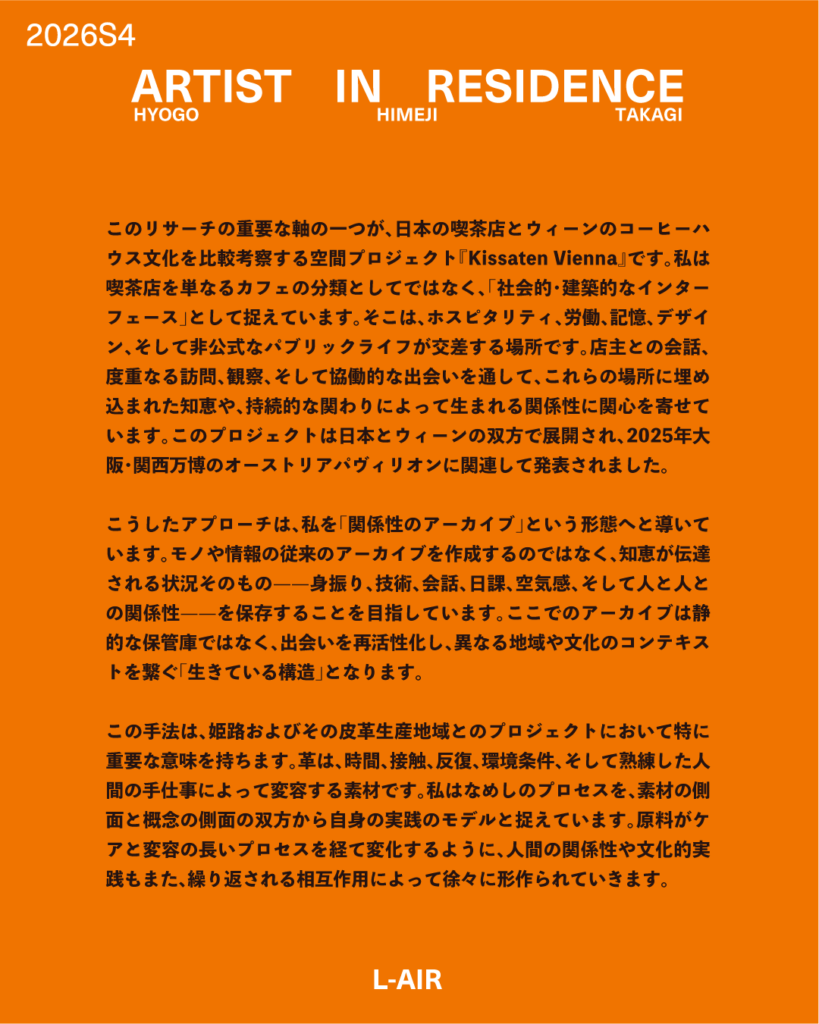
このリサーチの重要な軸の一つが、日本の喫茶店とウィーンのコーヒーハウス文化を比較考察する空間プロジェクト『Kissaten Vienna』です。私は喫茶店を単なるカフェの分類としてではなく、「社会的・建築的なインターフェース」として捉えています。そこは、ホスピタリティ、労働、記憶、デザイン、そして非公式なパブリックライフが交差する場所です。店主との会話、度重なる訪問、観察、そして協働的な出会いを通して、これらの場所に埋め込まれた知恵や、持続的な関わりによって生まれる関係性に関心を寄せています。このプロジェクトは日本とウィーンの双方で展開され、2025年大阪・関西万博のオーストリアパヴィリオンに関連して発表されました。
こうしたアプローチは、私を「関係性のアーカイブ(relational archiving)」という形態へと導いています。モノや情報の従来のアーカイブを作成するのではなく、知恵が伝達される状況そのもの——身振り、技術、会話、日課、空気感、そして人と人との関係性——を保存することを目指しています。ここでのアーカイブは静的な保管庫ではなく、出会いを再活性化し、異なる地域や文化のコンテキストを繋ぐ「生きている構造」となります。
この手法は、姫路およびその皮革生産地域とのプロジェクトにおいて特に重要な意味を持ちます。革は、時間、接触、反復、環境条件、そして熟練した人間の手仕事によって変容する素材です。私はなめしのプロセスを、素材の側面と概念の側面の双方から自身の実践のモデルと捉えています。原料がケアと変容の長いプロセスを経て変化するように、人間の関係性や文化的実践もまた、繰り返される相互作用によって徐々に形作られていきます。
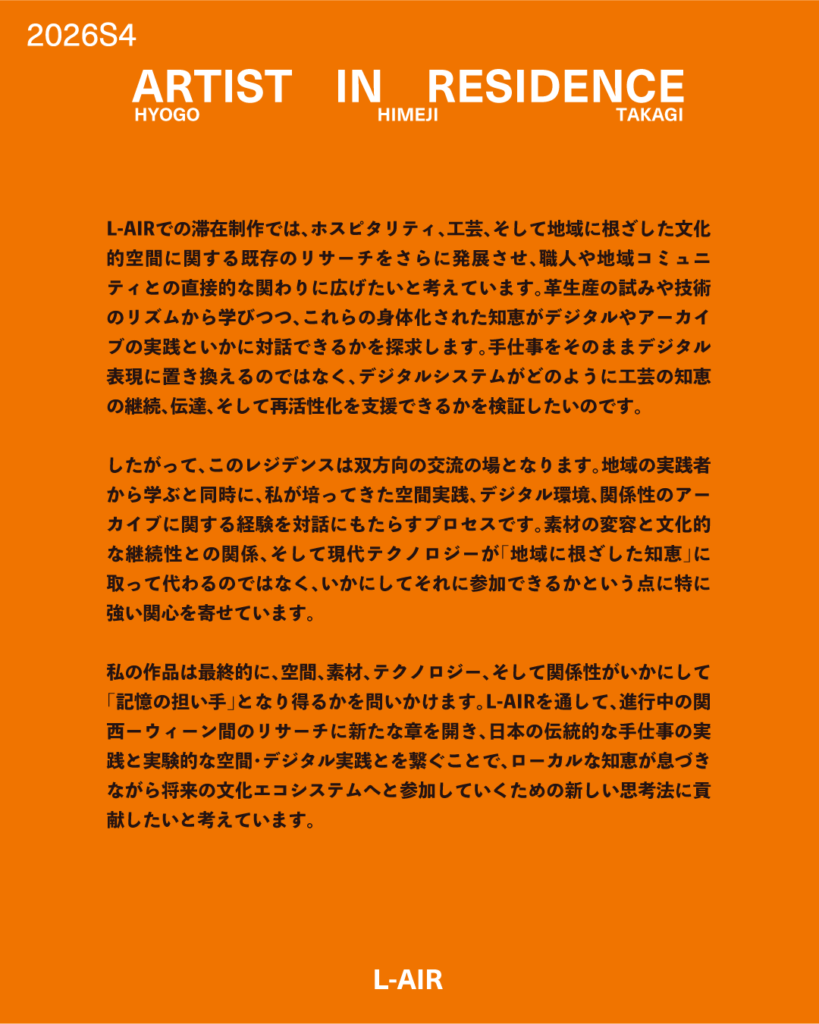
L-AIR(エル・エアー)での滞在制作では、ホスピタリティ、工芸、そして地域に根ざした文化的空間に関する既存のリサーチをさらに発展させ、職人や地域コミュニティとの直接的な関わりに広げたいと考えています。革生産の試みや技術のリズムから学びつつ、これらの身体化された知恵がデジタルやアーカイブの実践といかに対話できるかを探求します。手仕事をそのままデジタル表現に置き換えるのではなく、デジタルシステムがどのように工芸の知恵の継続、伝達、そして再活性化を支援できるかを検証したいのです。
したがって、このレジデンスは双方向の交流の場となります。地域の実践者から学ぶと同時に、私が培ってきた空間実践、デジタル環境、関係性のアーカイブに関する経験を対話にもたらすプロセスです。素材の変容と文化的な継続性との関係、そして現代テクノロジーが「ローカルに根ざした知恵」に取って代わるのではなく、いかにしてそれに参加できるかという点に特に強い関心を寄せています。
私の作品は最終的に、空間、素材、テクノロジー、そして関係性がいかにして「記憶の担い手」となり得るかを問いかけます。L-AIRを通して、進行中の関西ーウィーン間のリサーチに新たな章を開き、日本の伝統的な手仕事の実践と実験的な空間・デジタル実践とを繋ぐことで、ローカルな知恵が息づきながら将来の文化エコシステムへと参加していくための新しい思考法に貢献したいと考えています。
■参加にあたって
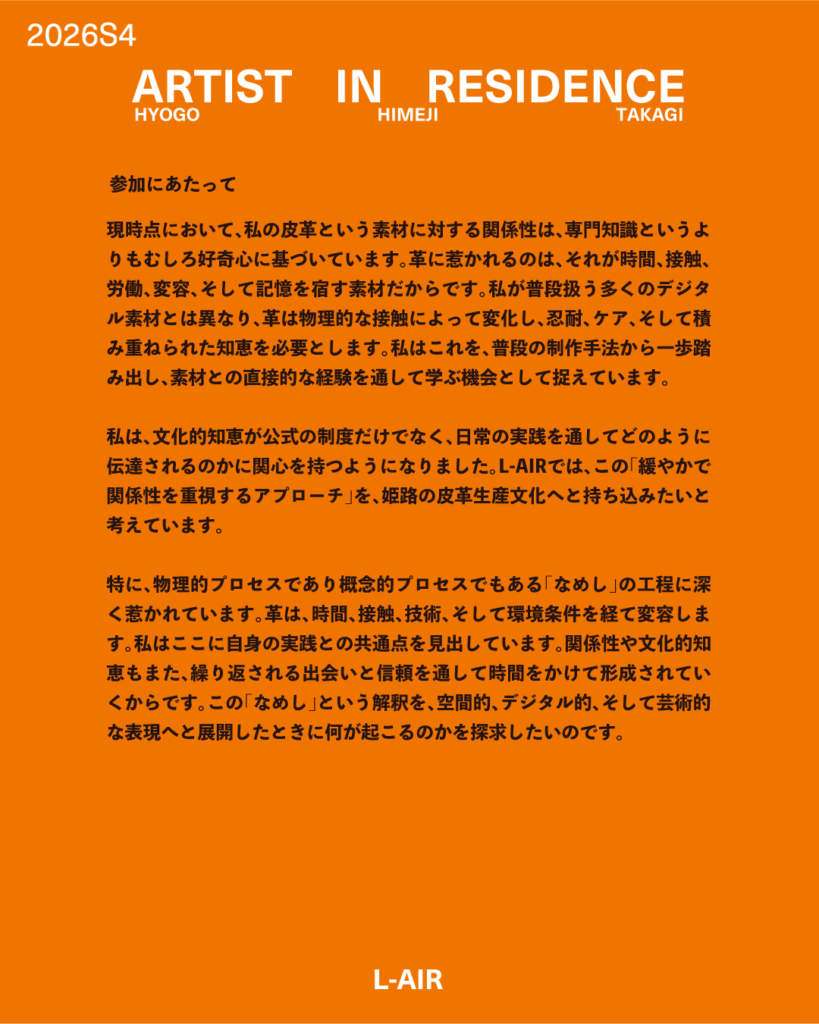
現時点において、私の皮革という素材に対する関係性は、専門知識というよりもむしろ好奇心に基づいています。革に惹かれるのは、それが時間、接触、労働、変容、そして記憶を宿す素材だからです。私が普段扱う多くのデジタル素材とは異なり、革は物理的な接触によって変化し、忍耐、ケア、そして積み重ねられた知恵を必要とします。私はこれを、普段の制作手法から一歩踏み出し、素材との直接的な経験を通して学ぶ機会として捉えています。
私は、文化的知恵が公式の制度だけでなく、日常の実践を通してどのように伝達されるのかに関心を持つようになりました。L-AIRでは、この「緩やかで関係性を重視するアプローチ」を、姫路の皮革生産文化へと持ち込みたいと考えています。
特に、物理的プロセスであり概念的プロセスでもある「なめし」の工程に深く惹かれています。革は、時間、接触、技術、そして環境条件を経て変容します。私はここに自身の実践との共通点を見出しています。関係性や文化的知恵もまた、繰り返される出会いと信頼を通して時間をかけて形成されていくからです。この「なめし」という解釈を、空間的、デジタル的、そして芸術的な表現へと展開したときに何が起こるのかを探求したいのです。
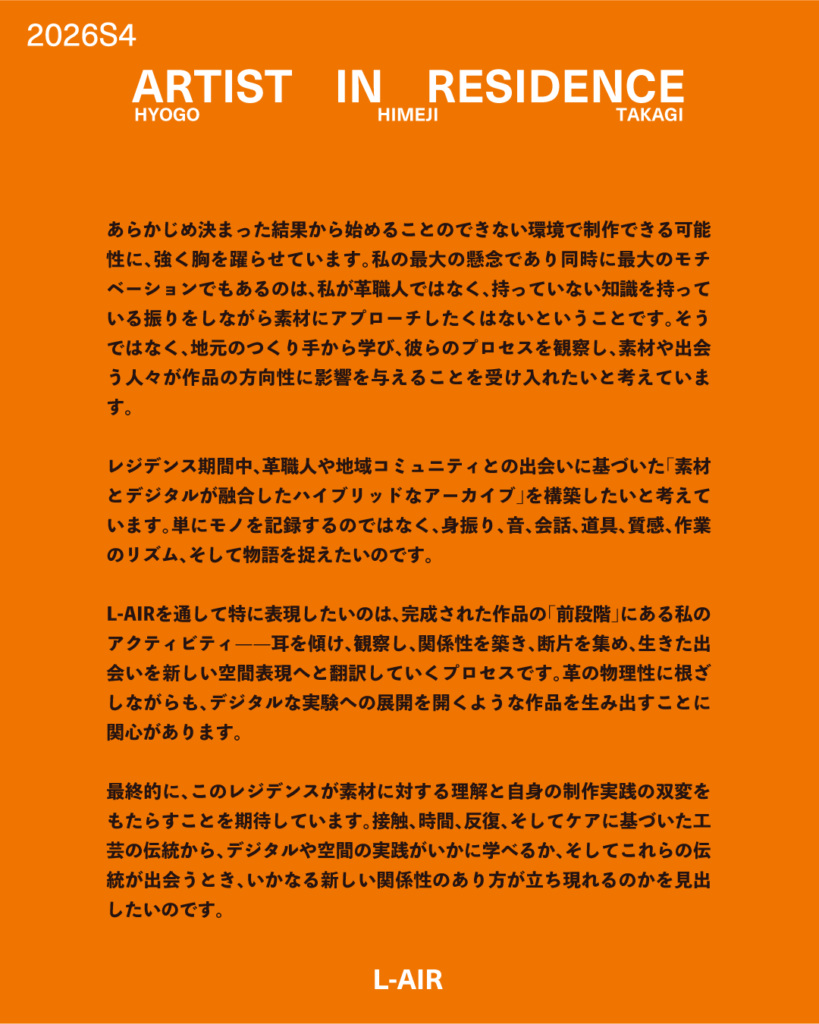
あらかじめ決まった結果から始めることのできない環境で制作できる可能性に、強く胸を躍らせています。私の最大の懸念であり同時に最大のモチベーションでもあるのは、私が革職人ではなく、持っていない知識を持っている振りをしながら素材にアプローチしたくはないということです。そうではなく、地元のつくり手から学び、彼らのプロセスを観察し、素材や出会う人々が作品の方向性に影響を与えることを受け入れたいと考えています。
レジデンス期間中、革職人や地域コミュニティとの出会いに基づいた「素材とデジタルが融合したハイブリッドなアーカイブ」を構築したいと考えています。単にモノを記録するのではなく、身振り、音、会話、道具、質感、作業のリズム、そして物語を捉えたいのです。
L-AIRを通して特に表現したいのは、完成された作品の「前段階」にある私のアクティビティ——耳を傾け、観察し、関係性を築き、断片を集め、生きた出会いを新しい空間表現へと翻訳していくプロセスです。革の物理性に根ざしながらも、デジタルな実験への展開を開くような作品を生み出すことに関心があります。
最終的に、このレジデンスが素材に対する理解と自身の制作実践の双変をもたらすことを期待しています。接触、時間、反復、そしてケアに基づいた工芸の伝統から、デジタルや空間の実践がいかに学べるか、そしてこれらの伝統が出会うとき、いかなる新しい関係性のあり方が立ち現れるのかを見出したいのです。
L-AIR ARTIST IN RESIDENCE & SUPPORT PROGRAM
2026 Season 3|Invited Artist Introduction
We are pleased to introduce Miron Rabetskii, the 15th artist invited to L-AIR and the artist for 2026 Season 4.
From October to December 2026, Miron will stay in Takagi, Himeji City, one of Japan’s leading leather-producing areas, and create new works during the residency.
L-AIR is a leather-focused Artist-in-Residence program based in Takagi, connecting artists from Japan and abroad with Himeji’s local leather industry.
Miron will explore new forms of expression through the fusion of his artistic practice and Himeji’s renowned leather industry.
We invite you to follow his creative journey and see what emerges.
■Artist
Miron Rabetskii
Early October to Sunday, December 20, 2026
Instagram → https://www.instagram.com/rebi.me
Born in Germany from Varazdin Croatia based in Vienna
Media artist, Experimental Filmaker, Digital Architect
■Biography
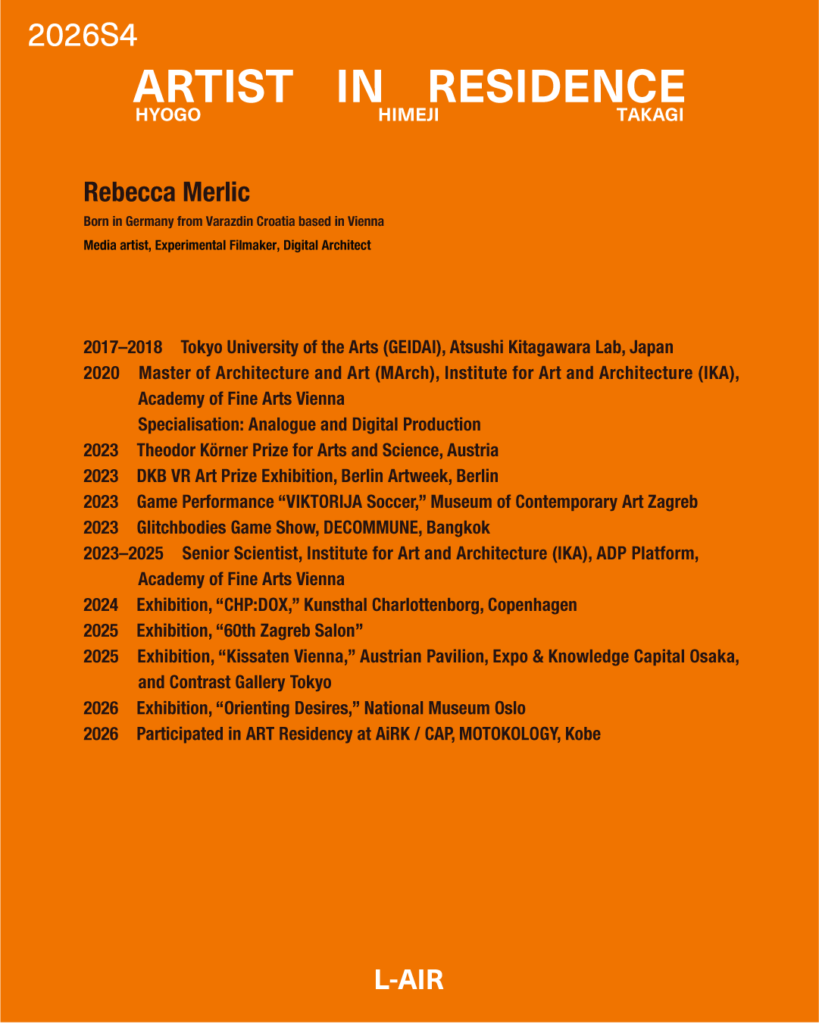
2017–2018 Tokyo University of the Arts (GEIDAI), Atsushi Kitagawara Lab, Japan
2020 Master of Architecture and Art (MArch), Institute for Art and Architecture (IKA), Academy of Fine Arts Vienna
Specialisation: Analogue and Digital Production
2023 Theodor Körner Prize for Arts and Science, Austria
2023 DKB VR Art Prize Exhibition, Berlin Artweek, Berlin
2023 Game Performance “VIKTORIJA Soccer,” Museum of Contemporary Art Zagreb
2023 Glitchbodies Game Show, DECOMMUNE, Bangkok
2023–2025 Senior Scientist, Institute for Art and Architecture (IKA), ADP Platform, Academy of Fine Arts Vienna
2024 Exhibition, “CHP:DOX,” Kunsthal Charlottenborg, Copenhagen
2025 Exhibition, “60th Zagreb Salon”
2025 Exhibition, “Kissaten Vienna,” Austrian Pavilion, Expo & Knowledge Capital Osaka, and Contrast Gallery Tokyo
2026 Exhibition, “Orienting Desires,” National Museum Oslo
2026 Participated in ART Residency at AiRK / CAP, MOTOKOLOGY, Kobe
■Artist Statement
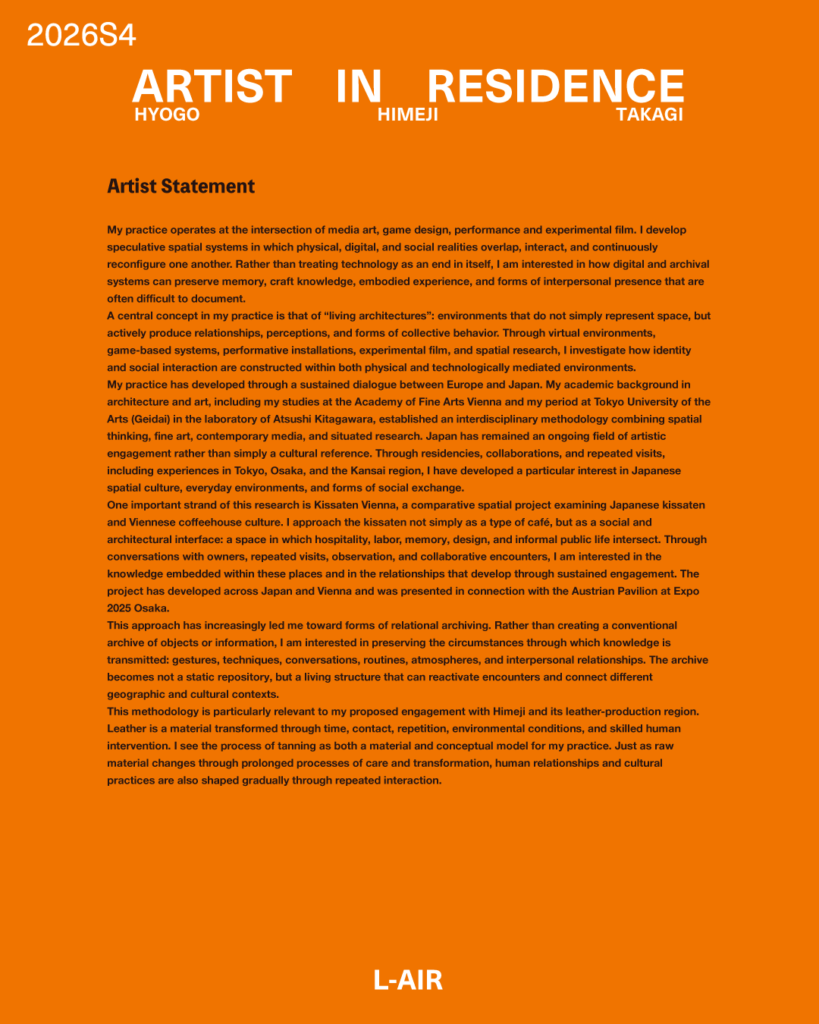
My practice operates at the intersection of media art, game design, performance and experimental film. I develop speculative spatial systems in which physical, digital, and social realities overlap, interact, and continuously reconfigure one another. Rather than treating technology as an end in itself, I am interested in how digital and archival systems can preserve memory, craft knowledge, embodied experience, and forms of interpersonal presence that are often difficult to document.
A central concept in my practice is that of “living architectures”: environments that do not simply represent space, but actively produce relationships, perceptions, and forms of collective behavior. Through virtual environments, game-based systems, performative installations, experimental film, and spatial research, I investigate how identity and social interaction are constructed within both physical and technologically mediated environments.
My practice has developed through a sustained dialogue between Europe and Japan. My academic background in architecture and art, including my studies at the Academy of Fine Arts Vienna and my period at Tokyo University of the Arts (Geidai) in the laboratory of Atsushi Kitagawara, established an interdisciplinary methodology combining spatial thinking, fine art, contemporary media, and situated research. Japan has remained an ongoing field of artistic engagement rather than simply a cultural reference. Through residencies, collaborations, and repeated visits, including experiences in Tokyo, Osaka, and the Kansai region, I have developed a particular interest in Japanese spatial culture, everyday environments, and forms of social exchange.
One important strand of this research is Kissaten Vienna, a comparative spatial project examining Japanese kissaten and Viennese coffeehouse culture. I approach the kissaten not simply as a type of café, but as a social and architectural interface: a space in which hospitality, labor, memory, design, and informal public life intersect. Through conversations with owners, repeated visits, observation, and collaborative encounters, I am interested in the knowledge embedded within these places and in the relationships that develop through sustained engagement. The project has developed across Japan and Vienna and was presented in connection with the Austrian Pavilion at Expo 2025 Osaka.
This approach has increasingly led me toward forms of relational archiving. Rather than creating a conventional archive of objects or information, I am interested in preserving the circumstances through which knowledge is transmitted: gestures, techniques, conversations, routines, atmospheres, and interpersonal relationships. The archive becomes not a static repository, but a living structure that can reactivate encounters and connect different geographic and cultural contexts.
This methodology is particularly relevant to my proposed engagement with Himeji and its leather-production region. Leather is a material transformed through time, contact, repetition, environmental conditions, and skilled human intervention. I see the process of tanning as both a material and conceptual model for my practice. Just as raw material changes through prolonged processes of care and transformation, human relationships and cultural practices are also shaped gradually through repeated interaction.
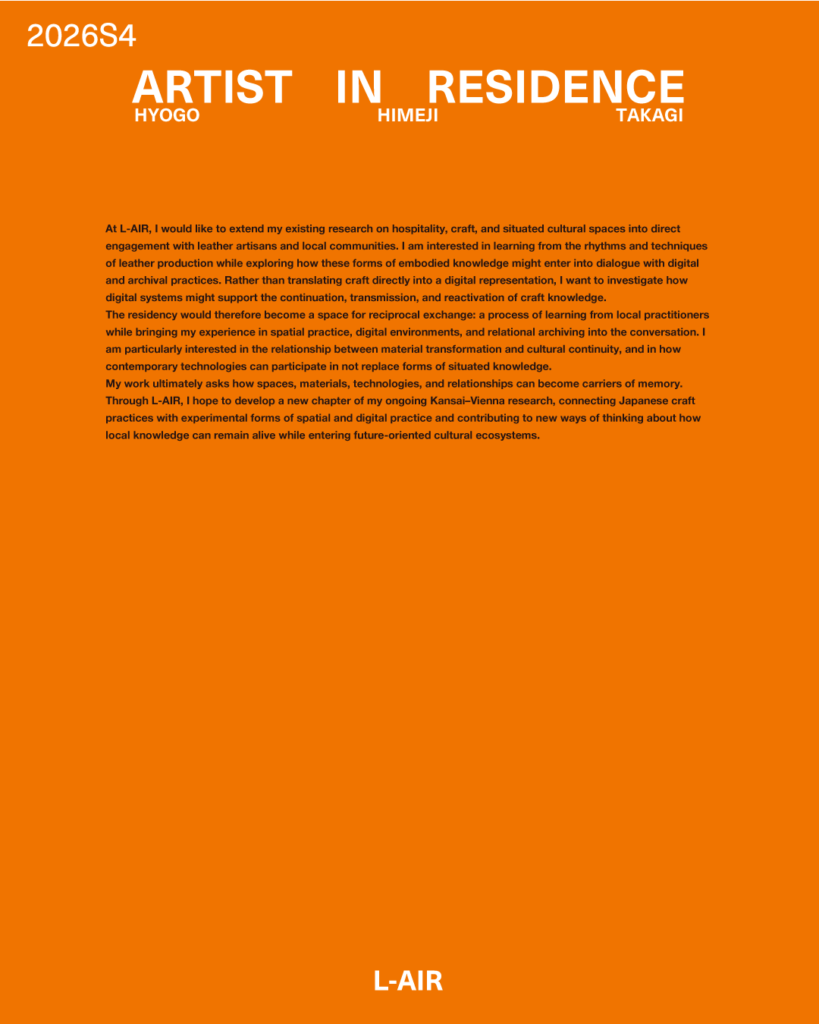
At L-AIR, I would like to extend my existing research on hospitality, craft, and situated cultural spaces into direct engagement with leather artisans and local communities. I am interested in learning from the rhythms and techniques of leather production while exploring how these forms of embodied knowledge might enter into dialogue with digital and archival practices. Rather than translating craft directly into a digital representation, I want to investigate how digital systems might support the continuation, transmission, and reactivation of craft knowledge.
The residency would therefore become a space for reciprocal exchange: a process of learning from local practitioners while bringing my experience in spatial practice, digital environments, and relational archiving into the conversation. I am particularly interested in the relationship between material transformation and cultural continuity, and in how contemporary technologies can participate in not replace forms of situated knowledge.
My work ultimately asks how spaces, materials, technologies, and relationships can become carriers of memory. Through L-AIR, I hope to develop a new chapter of my ongoing Kansai–Vienna research, connecting Japanese craft practices with experimental forms of spatial and digital practice and contributing to new ways of thinking about how local knowledge can remain alive while entering future-oriented cultural ecosystems.
■Motivation for Participating in L-AIR
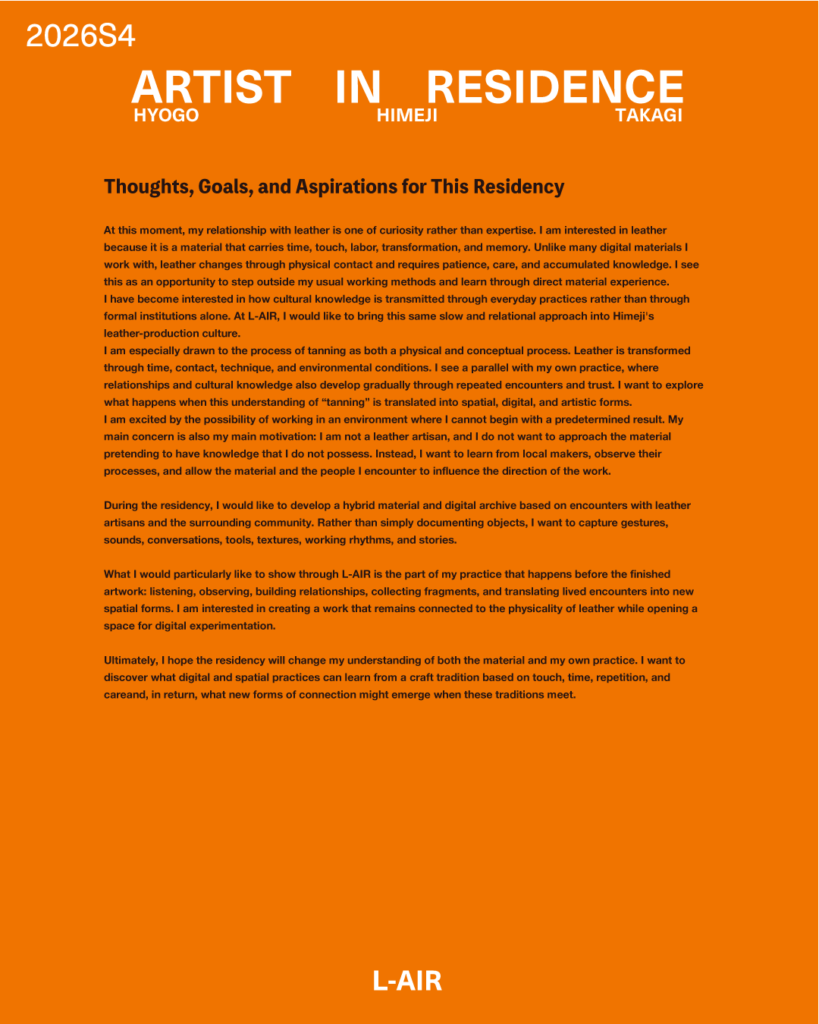
At this moment, my relationship with leather is one of curiosity rather than expertise. I am interested in leather because it is a material that carries time, touch, labor, transformation, and memory. Unlike many digital materials I work with, leather changes through physical contact and requires patience, care, and accumulated knowledge. I see this as an opportunity to step outside my usual working methods and learn through direct material experience.
I have become interested in how cultural knowledge is transmitted through everyday practices rather than through formal institutions alone. At L-AIR, I would like to bring this same slow and relational approach into Himeji’s leather-production culture.
I am especially drawn to the process of tanning as both a physical and conceptual process. Leather is transformed through time, contact, technique, and environmental conditions. I see a parallel with my own practice, where relationships and cultural knowledge also develop gradually through repeated encounters and trust. I want to explore what happens when this understanding of “tanning” is translated into spatial, digital, and artistic forms.
I am excited by the possibility of working in an environment where I cannot begin with a predetermined result. My main concern is also my main motivation: I am not a leather artisan, and I do not want to approach the material pretending to have knowledge that I do not possess. Instead, I want to learn from local makers, observe their processes, and allow the material and the people I encounter to influence the direction of the work.
During the residency, I would like to develop a hybrid material and digital archive based on encounters with leather artisans and the surrounding community. Rather than simply documenting objects, I want to capture gestures, sounds, conversations, tools, textures, working rhythms, and stories.
What I would particularly like to show through L-AIR is the part of my practice that happens before the finished artwork: listening, observing, building relationships, collecting fragments, and translating lived encounters into new spatial forms. I am interested in creating a work that remains connected to the physicality of leather while opening a space for digital experimentation.
Ultimately, I hope the residency will change my understanding of both the material and my own practice. I want to discover what digital and spatial practices can learn from a craft tradition based on touch, time, repetition, and careand, in return, what new forms of connection might emerge when these traditions meet.